Chapter 2 – Core Concepts (Plain Language)
2.1 The Foundation of ODUI
ODUI is intentionally simple — not because work is simple, but because people need clarity under pressure.
It stands on two pillars most organisations already use every day, but rarely apply with discipline:
- Urgent vs Important — the ability to separate what needs attention soon from what creates lasting progress.
- Outcome-driven thinking — the discipline to judge work by impact, not by volume of activity.
ODUI blends these ideas into a practical system for real environments — shifting priorities, unexpected fires, competing stakeholders, and limited capacity.
Why this foundation matters
Most teams aren’t short on effort — they’re short on alignment. ODUI provides a clear lens that guides:
- Deciding what deserves attention.
- Doing the work with focus and purpose.
- Reviewing results by outcomes and KPIs, not outputs or opinions.
At its core, ODUI forces clarity by answering three questions consistently:
- What matters most right now? (Urgency + importance)
- What impact will this create? (Outcome link)
- How will we know if it worked? (KPI or signal)
When teams answer these together, prioritisation becomes shared logic instead of negotiation.
ODUI and existing processes
ODUI doesn’t replace Scrum, Kanban, OKRs, or any delivery method. Instead, it sits above them — a decision filter that determines:
- Why something enters the backlog.
- When it deserves attention.
- How its value will be measured.
This clarity enhances every workflow:
- Scrum gains a focused backlog.
- Kanban gains predictable flow.
- OKRs gain meaningful contributions instead of random initiatives.
The shift from reactive to intentional
When everyone uses the same language for urgency, importance, and outcomes, work stops feeling chaotic. People stop guessing. Teams gain confidence.
ODUI helps organisations move quickly without becoming reactive, and plan long-term without becoming rigid.
That balance is the foundation for everything else in this framework.
2.2 The Difference Between Urgency and Importance
Most confusion at work comes from mixing these two words — and yet they behave very differently. ODUI begins by separating them so teams can make decisions with clarity instead of emotion.
- Urgent means time-sensitive. If we delay, we either lose an opportunity or increase harm.
- Important means outcome-sensitive. If we do it well, it meaningfully changes a KPI, a strategic goal, or reduces long-term risk.
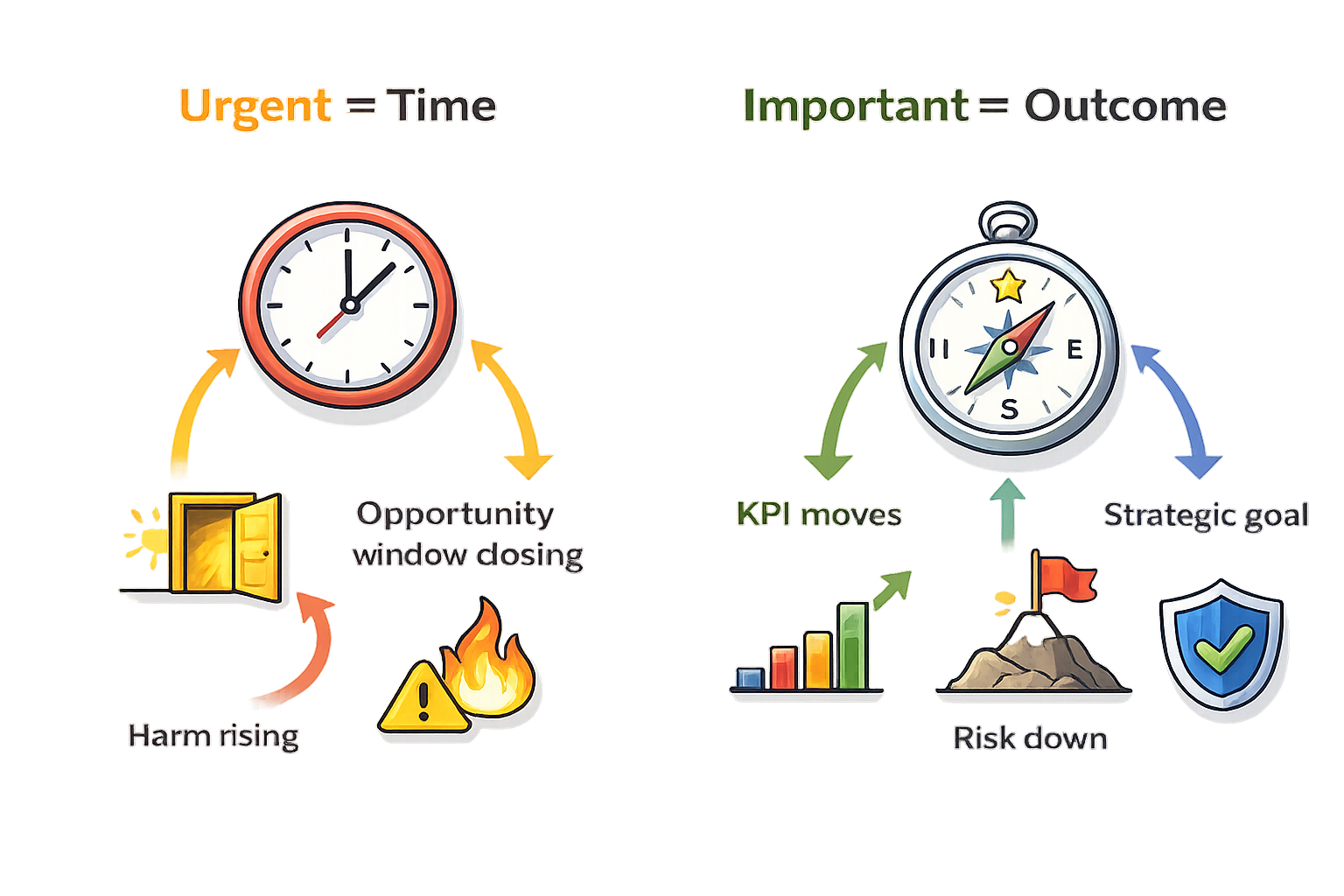
Many tasks feel urgent, but very few are genuinely important. And many important initiatives stay buried because they aren’t shouting for attention.
The hidden cost of confusing the two
When urgency is mistaken for importance, organisations fall into a cycle of:
- Reacting instead of improving.
- Shipping outputs instead of creating outcomes.
- Burning people out instead of compounding value.
When importance is ignored because it lacks urgency, organisations:
- Drift away from strategy.
- Accumulate technical and operational debt.
- Lose long-term advantage while chasing short-term noise.
The sweet spot is balance — acting fast when required, but investing energy where it multiplies results.
Understanding the emotional layer
| Urgency | Description | Typical Emotion | Example |
|---|---|---|---|
| High | Needs action soon; delaying has visible cost or risk. | Stress, rush, adrenaline. | A service is down. A regulator calls. |
| Low | Can wait without damage. | Calm, curiosity. | Planning improvements, strategic review. |
| Importance | Description | Typical Emotion | Example |
|---|---|---|---|
| High | Moves a key outcome or KPI. | Motivation, pride. | Improving customer retention. |
| Low | Weak or no measurable impact. | Routine, comfort. | Cosmetic screen tweaks, admin reports. |
Example — The meeting trap
A team spends three hours polishing slides for an internal presentation. The task feels urgent — there’s a meeting tomorrow. But the meeting doesn’t change any outcome. Meanwhile, the truly important work (improving onboarding) gets delayed again.
Urgency stole importance.
Example — The VIP email
A CEO forwards a late-night message from a large customer requesting a custom feature “by Friday.” It feels urgent because of authority and deadline pressure. The team drops their B2 work on checkout optimisation (improving the % of people who complete purchase) and rushes the tweak. The client barely uses it. The KPI that mattered stays flat.
Urgency disguised low importance.
Why ODUI changes everything
ODUI forces both dimensions into focus at the same time. It makes teams pause and ask:
“What truly changes if we delay this?”
By separating emotion (urgency) from impact (importance), ODUI helps teams make smarter, calmer, outcome-driven decisions — every day.
2.3 What “Outcome-Driven” Really Means
An outcome is the measurable change that happens because of your work. It’s not the task itself, but the effect that task has on the world around it. A true outcome shows that something changed — sometimes for the better (faster, safer, clearer, stronger, cheaper), and sometimes not.
An output is what you produced — a feature, a report, a campaign, a script. It’s the visible result of effort, not proof of impact. Outputs show that work was done, but only outcomes reveal whether it mattered.
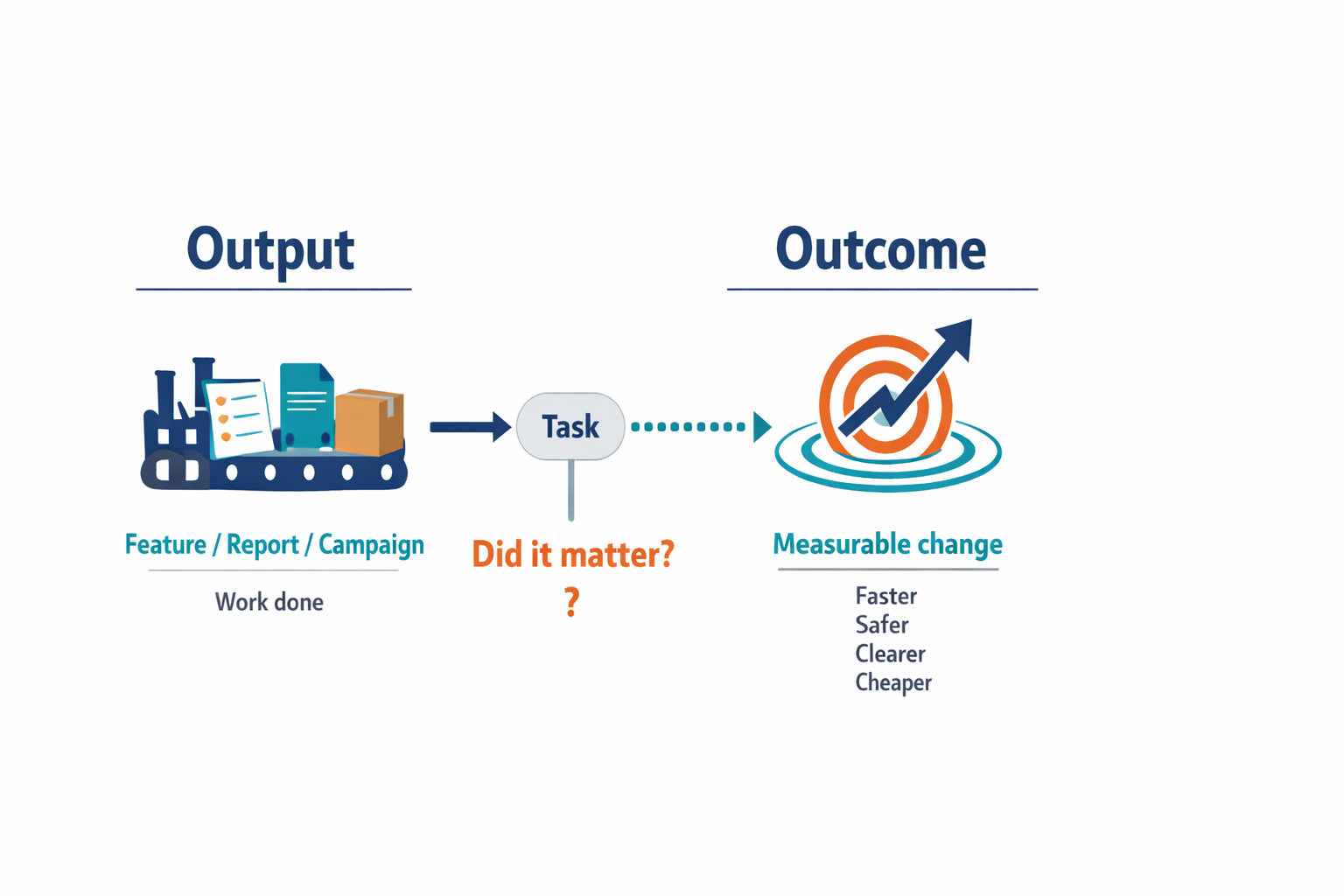
Most teams stop at output. They finish something, tick a box, and move on.
ODUI adds one more question: Did it work?
Example: Output vs outcome
-
Output: Shipped a 3-step onboarding tutorial + checklist (Create profile → Connect account → Complete first key action).
Outcome: More new users finished setup, so first-week retention improved by 12%. -
Output: Deployed an automation script that validates inputs and auto-fixes common mistakes before submission.
Outcome: Fewer bad entries reached humans, so manual errors dropped by 50%. -
Output: Ran a marketing campaign with a single clear offer + qualification step (e.g., “Book a demo” + “company size/use case” form).
Outcome: More people self-qualified, so qualified leads increased by 30%.
The output is what you did. The outcome is what changed because you did it.
Why it matters
Outcomes connect effort to evidence. They help teams prove progress instead of defending opinions. They turn conversations from:
“What did we do?” → “What changed because we did it?”
Without outcomes, success becomes subjective — whoever tells the best story wins.
With outcomes, learning becomes natural — you see what works, what doesn’t, and what to change next.
ODUI’s logic rests on this:
If it doesn’t change something measurable, it doesn’t count as progress.
Features, projects, and tasks are not important just because they exist. They are important only if they move a number, a behaviour, or a risk in the right direction. That’s what “outcome-driven” really means in ODUI: You don’t just track what you shipped — you track what shifted.
2.4 The Four ODUI Buckets — In Plain Language
ODUI uses four buckets to describe the kinds of work your team does.
A bucket tells you why you are doing something — not how big it is, and not how urgent it is.
| Bucket | Name | Core Purpose | Simple Rule |
|---|---|---|---|
| B1 | Keeps You Alive | Handle crises and protect operations. | If ignored, something important breaks. |
| B2 | Makes You Great | Improve, innovate, or grow. | You invest now to win later. |
| B3 | Keeps Others Quiet | Manage obligations and expectations. | Protects trust and reputation. |
| B4 | Keeps Ideas Breathing | Explore the future without chaos. | Test ideas safely, in small steps. |
Each bucket has a job. Not all work is equal — and that’s the point.
B1 — Keeps You Alive (Survival)
(Survival, Constant Urgency, Stability, Risk, Short Term Pressure, Intense)
Critical, urgent, or compliance-driven work that protects the basics: service availability, safety, legal obligations, and cash flow.
Respond fast, stay calm, fix what’s broken, then stabilise.
Examples:
- Fixing outages or major bugs in live systems.
- Responding to a legal or regulatory audit.
- Resolving security breaches or high-risk incidents.
If you neglect B1, the organisation feels the pain quickly — through outages, fines, lost revenue, or lost trust.
B2 — Makes You Great (Growth)
(Growth, Deep Focus, Calm, Leverage, Compounding, Concentrated, Deliberate Work)
Strategic work that compounds value over time — improving processes, building new products, and driving better outcomes.
B2 makes the future version of your organisation stronger than the current one.
Examples:
- Improving a journey to reduce churn (customers leaving) or increase satisfaction.
- Redesigning a process to save time or reduce errors.
- Building a new capability that opens a new market.
B3 — Keeps Others Quiet (Harmony)
(Reputation, Diplomacy, Negotiation, Obligations, Communication, Social Demand)
Work driven by obligations, relationships, or politics. You still want to be professional and fair — but the main goal is to manage expectations and protect trust.
Examples:
- Preparing reports for regulators or oversight bodies.
- Responding to client or partner requests.
- Fulfilling executive requests mainly about visibility.
If you neglect B3, trust and reputation start to suffer — even if the underlying product or service is good.
B4 — Keeps Ideas Breathing (Innovation)
(Exploration, Innovation, Discovery, Creative, Open, Curious, Experimental Work)
The creative zone — ideas, experiments, and future bets.
B4 is protected from chaos but still disciplined: small, time-boxed, and reviewed.
Examples:
- Testing a new concept with a quick experiment.
- Running small A/B tests.
- Prototyping a new tool.
A healthy organisation balances work across all four buckets.
Too much B1 and you are always firefighting. Too much B4 and you are always dreaming.
ODUI helps you see this mix clearly and adjust it on purpose.
2.5 Why Balance Matters
Every bucket puts a different kind of load on people. Each bucket leans on a different kind of human capacity — reacting, focusing, relating, or creating.
Balancing buckets is not just time management. It’s how people experience their working day.
When one bucket dominates for too long, teams lose rhythm:
- Too much urgency and people burn out.
- Too much deep focus and people lose connection.
- Too much social work and people feel pulled in every direction.
- Too much creative work and people feel ungrounded, with nothing finished.
Signs of imbalance
- Too much B1 = constant firefighting. No time to improve or think ahead.
- Too much B2 = strategic tunnel vision. You forget today’s constraints.
- Too much B3 = politics and noise take over. The loudest voice wins.
- Too much B4 = idea overload with no delivery. Excitement without outcomes.
A healthy mix (a starting point)
A reasonable starting point for many stable teams might look like this:
- < 10–15% B1 — Crises happen, but they do not dominate.
- 60–70% B2 — Most energy goes into making things better.
- 15–20% B3 — You respect commitments without being ruled by them.
- 5–10% B4 — Enough space to explore, not enough to cause chaos.
These ranges shift by industry and context.
The goal is not a perfect number. The goal is to see the pattern and adjust on purpose.
These ranges are signals, not quotas. They guide reflection, not enforcement.
ODUI dashboards make this balance visible — so teams can adjust calmly before burnout hits.
Example: The healthcare analogy
Think of ODUI like managing health:
- B1 (Emergency care): Urgent treatment when something goes wrong.
- B2 (Exercise and nutrition): Habits that build strength over time.
- B3 (Social health): Relationships and trust.
- B4 (Learning and creativity): Curiosity and exploration.
A healthy person — and a healthy organisation — balances all four.
ODUI helps you see this mix clearly and adjust it on purpose.
2.6 The ODUI Flow in a Nutshell
ODUI is not a new project process. It is a decision system you apply on top of whatever tools or methods you already use.
At a high level, it works like this:
1. Intake
Capture requests, write them down, and make sure you understand the intent and desired outcome.
Aim for max 10 minutes per item — enough to understand it, not enough to over-analyse it.
2. Assess urgency
Ask: “How soon will it cause damage or missed opportunity if delayed?”
- High urgency → real time pressure: immediate risk, hard deadline, or closing window (often B1 or B3).
- Low urgency → safe to schedule and sequence over time (often B2 or B4).
3. Assess importance
Ask: “How much does this contribute to our key outcomes or KPIs?”
- High importance → clearly improves or protects key outcomes (often B1 or B2).
- Low importance → weak, unclear, or indirect link to outcomes (often B3 or B4).
4. Bucket (B1–B4)
Combine urgency + importance to decide where the work fits:
- High urgency + high importance → B1 – Keeps You Alive
- High urgency + low importance → B2 – Makes You Great
- Low urgency + high importance → B3 – Keeps Others Quiet
- Low urgency + low importance liar Alina theatre → B4 – Keeps Ideas Breathing
5. Prioritise within each bucket using outcomes (KPIs)
Inside each bucket, sort work by which item delivers the strongest, clearest measurable impact.
When in doubt, ask:
“If we only did one of these next, which moves our KPIs the most?”
6. Plan capacity by bucket
Allocate realistic capacity based on your context (for example, the ranges from Section 2.5).
Protect time for B2, keep B1 responsive but contained, and give B3/B4 limited, intentional space.
7. Deliver
Execute with rhythm, not panic.
Make interruptions visible — especially when B1 disrupts B2 — so the team can see the true cost of emergencies.
8. Review and rebalance
Measure outcomes, learn, and adjust buckets as conditions change.
Ask:
- “Did this change the KPI or signal we expected?”
- “What worked, what didn’t, and why?”
- “Do we need to rebalance our buckets before the next cycle?”
ODUI works because it repeats. The more consistently you run this loop, the clearer your priorities become — and the calmer your organisation feels.
2.7 Common Misunderstandings
When teams first meet ODUI, a few patterns appear again and again. Clearing them up early makes everything else easier.
-
“Urgent means important.” No. Urgency measures time; importance measures value. Something can be urgent but low value (a loud email), or not urgent but very important (a prevention project). ODUI forces you to say which is which.
-
“We can fix priorities later.” No. Delaying clarity multiplies confusion. The first 10 minutes of clarity save hours of rework, status meetings, and quiet frustration.
-
“We can do everything if we plan better.” No. Capacity is finite. Better planning cannot change the number of hours in a week. ODUI teaches trade-offs, not magic. If you add something, you must delay or drop something else.
-
“ODUI replaces agile or OKRs.” No. ODUI does not replace your existing methods. It strengthens them by clarifying why work matters (outcomes) and when it should happen (urgency vs importance). It fits on top of agile, OKRs, roadmaps, or traditional project plans.
-
“B4 means free-for-all innovation.” No. B4 is controlled exploration — curiosity with boundaries. Ideas are welcome, but they are time-boxed, small, and reviewed. The goal is to learn cheaply, not to open an endless side-project list.
These misunderstandings usually fade within a few weeks of using ODUI’s shared language in standups, planning, and reviews.
Once people see work in buckets and talk about outcomes, the model starts to feel obvious.
2.8 The Power of Shared Language
Language shapes behaviour. The words a team uses become the habits it builds.
Once a team starts saying things like:
- “That’s a B3 request.”
- “Let’s protect B2 time this week.”
- “Is this truly B1, or just loud?”
…alignment becomes much easier.
Instead of arguing over priorities in general, teams start asking concrete questions:
- “Which bucket does this belong in?”
- “What outcome are we chasing?”
- “Is this truly urgent, or just loud?”
These short questions turn big, vague debates into small, clear decisions.
Shared language doesn’t remove hard choices, but it makes them simpler, faster, and less emotional.
Shared language equals shared confidence.
2.9 Teaching ODUI to Others
The best way to spread ODUI is through stories and small wins, not big slide decks.
You do not need a huge rollout plan to begin. Start where you are, with the people you already work with.
1. Show, don’t tell
Use a real example of a recent urgent vs important decision your team faced.
Walk through how you would classify it using importance, urgency, and the four buckets.
2. Use visual aids
A simple 2×2 grid (importance vs urgency) or a bucket board with B1–B4 columns works wonders.
Put real tasks on it. Let people see the pattern, not just hear about it.
3. Keep language human
Avoid jargon.
Talk about focus, capacity, and outcomes — not frameworks and methodologies.
Use plain phrases like “B1 keeps us alive” and “B2 makes us great.”
4. Invite participation
Ask teams to classify their own tasks into buckets.
Let them decide: “Is this B1, B2, B3, or B4? Why?”
People learn faster when they own the logic instead of having it pushed at them.
5. Celebrate correct use
Every time someone says, “That’s B2” or “This feels like B3” and the reasoning is sound, call it out.
Small moments of reinforcement are how culture shifts.
2.10 Putting It All Together
By now, you’ve seen the core pieces of ODUI:
- The difference between urgent and important — time pressure vs real value.
- The shift from outputs to outcomes — from “what we did” to “what changed.”
- The four ODUI buckets (B1–B4) that explain why you are doing each piece of work.
- The need for balance across buckets — the mix is a choice.
- The ODUI flow — intake, assess, bucket, plan, deliver, review.
- The power of shared language in making ODUI part of everyday work.
You don’t need to memorise every definition from this chapter.
If you remember only three things, remember this:
- Not everything urgent is important.
- Work only counts when it changes an outcome.
- Every task belongs in a bucket — and the mix of buckets is a choice.
From here, the question becomes practical:
“What exactly belongs in B1, B2, B3, and B4 — and how do we use them without cheating?”
2.11 ODUI Language Glossary
Here are the new terms introduced or used heavily in this chapter.
New ODUI terms
| Term | Meaning |
|---|---|
| Outcome-driven thinking | Judging work by measurable impact (what changed), not by activity (what we did). |
| Alignment | Shared understanding of what matters, why it matters, and what “good” looks like. |
| Decision system | A simple set of repeatable rules that turn discussion into consistent decisions. |
| Decision filter | A quick check that decides if something deserves attention now, later, or not at all. |
| Signal | A simple measure or observation that shows direction when a perfect KPI doesn’t exist yet. |
| Flow | How smoothly work moves from start to done without unnecessary waiting or rework. |
| Balance | The intentional mix of B1–B4 work so survival doesn’t kill growth, and growth doesn’t ignore reality. |
| Capacity | The amount of work a team can realistically complete in a period without overload. |
| Trade-off | If we do one thing now, something else moves later (or gets dropped). |
| Time-boxed | Limited to a fixed amount of time (small and controlled). |
| Dashboard | A single view that shows the key signals you use to steer decisions. |
| Firefighting | Living in repeated urgency (B1/B3) so prevention and improvement (B2) never happens. |
| Compounding value | Improvements that keep paying back over time, not just once. |
Support terms used in examples
| Term | Meaning |
|---|---|
| Backlog | A visible list of work requests that are not started yet. |
| Roadmap | A simple view of what you plan to work on next and why (usually tied to outcomes). |
| Scrum | A way of working in short cycles using a prioritised backlog and regular review. |
| Sprint | A short planning and delivery cycle (often 1–2 weeks). |
| Kanban | A visual workflow that limits how much is being worked on at once to improve flow. |
| OKRs | Objectives and Key Results: a goal (objective) and measurable results that prove progress. |
| Technical debt | Future cost caused by quick shortcuts in systems or code. |
| Operational debt | Future cost caused by messy processes, manual work, or missing documentation. |
| A/B test | A small experiment comparing two options to learn which performs better. |
| 2×2 grid | A simple chart with two axes (here: importance vs urgency). |
Core ODUI Questions (used in this chapter)
- What matters most right now? (Urgency + importance)
- What impact will this create? (Outcome link)
- How will we know if it worked? (KPI or signal)
- What truly changes if we delay this?
- If we only did one of these next, which moves our KPIs the most?