Chapter 4 – Scoring Importance (Outcome-Driven Logic)
4.1 Why Importance Needs a System
“Importance” is one of the most used and least understood words in the workplace. Ask five people what it means, and you’ll get five different answers. For one person, it’s about what their manager asked for. For another, it’s about what will help their customer. For a third, it’s whatever sounds urgent today. This confusion creates noise — everyone believes their work is the most important, and every meeting turns into a debate about whose view should win.
Without a shared logic, “importance” becomes a matter of power and personality. The loudest voice, the highest title, or the most dramatic story often decides what gets done. This is not strategy; it’s survival politics. Over time, this behaviour erodes trust. Teams start to see prioritisation as negotiation rather than alignment. They learn that being persuasive matters more than being impactful.
The ODUI Framework fixes this by replacing opinions with evidence-based logic. It turns the question of “what’s important?” into a structured conversation grounded in measurable outcomes. Instead of debating who deserves attention, teams examine which actions produce the greatest impact on the goals that matter. Importance shifts from who wants it to what changes if we do it.
Having a system brings fairness and focus. When people can see how importance is evaluated, they stop fighting for airtime and start contributing to results. It transforms emotional discussions into rational decisions.
Without a System vs With ODUI
Without a system:
- Prioritisation becomes political and emotionally charged.
- Teams waste energy defending their decisions instead of delivering outcomes.
- People lose trust in planning and start working around the process.
- “Importance” quietly means “who shouted last or loudest.”
With ODUI:
- Every decision connects directly to evidence, not emotion.
- Stakeholders can see exactly how trade-offs were made.
- Teams stop competing for visibility and start aligning around contribution.
- Leaders can explain “why this, why now” with confidence and consistency.
A Simple Working Definition
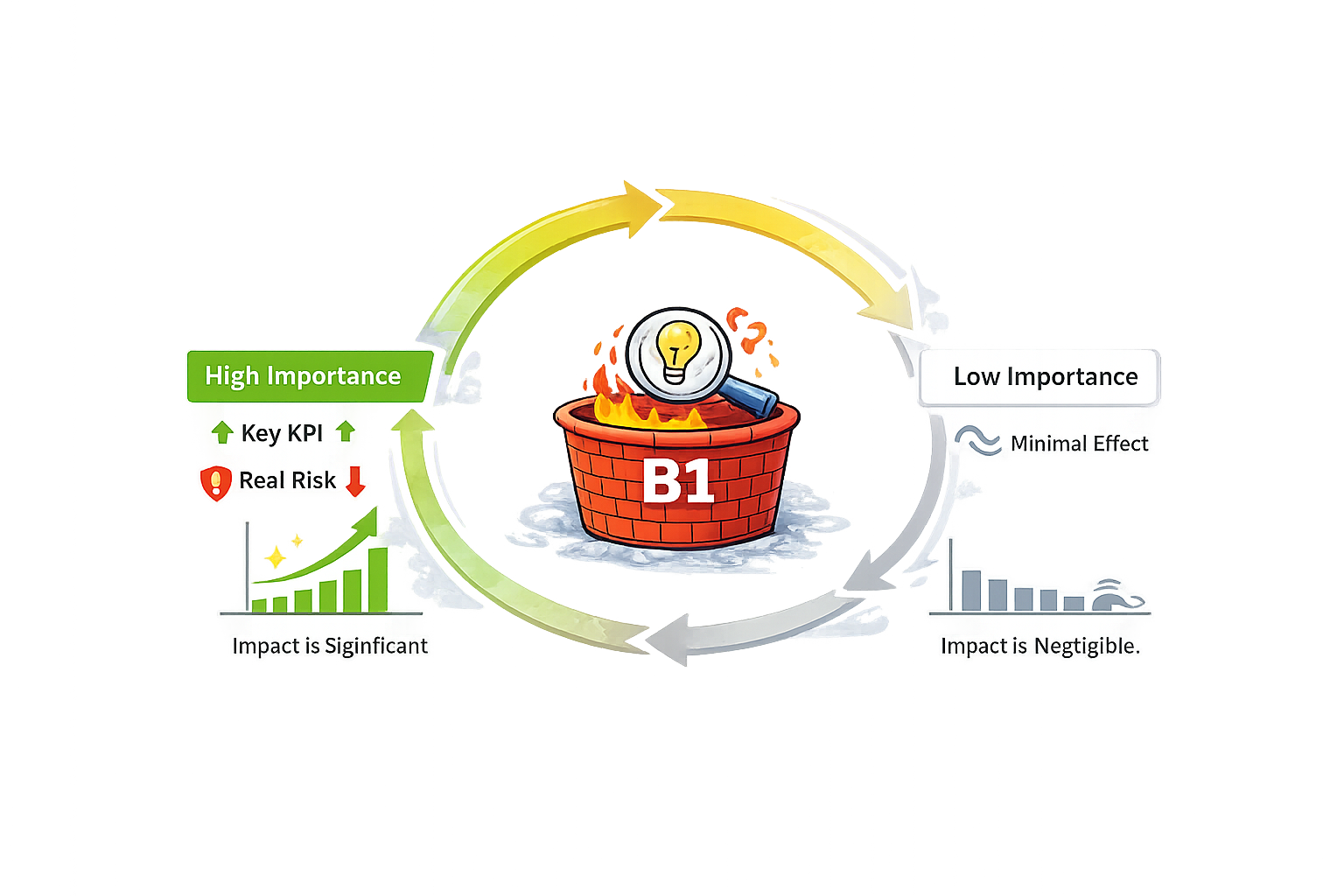
In ODUI, importance is not a feeling or a title. It is:
The size of the outcome change we can reasonably expect if this work succeeds.
Put simply:
- If doing the work clearly moves a key KPI or reduces a real risk → high importance.
- If doing the work barely moves anything that matters → low importance.
This definition keeps everyone anchored on outcomes instead of opinions.
A Quick Example
Two requests arrive on Monday:
- A senior manager wants a new internal dashboard layout for their weekly meeting.
- The team has an improvement ready that will reduce user churn in the first 30 days.
Both arrive with strong language: “I need this now.” But viewed through ODUI:
- The dashboard change helps one person feel more comfortable.
- The churn-reduction work affects hundreds or thousands of users and a core revenue KPI.
Under an ODUI lens, the churn work is objectively more important, even if it feels less noisy in the moment.
Why a System Protects Relationships
A system also protects relationships. When the logic is transparent, people are less likely to take deprioritisation personally. A team can say “not now” without causing conflict, because the reasoning is visible and fair.
Instead of:
- “We’re not doing your work.”
ODUI lets you say:
- “Right now we’re investing in the work that moves these specific outcomes most. Here is how your request scored, and when we’ll review it again.”
That clarity builds psychological safety — everyone knows decisions are made to serve shared outcomes, not personal agendas.
In this way, ODUI gives organisations a common language for importance. It makes decisions repeatable and trustworthy, not reactive or political. The framework turns prioritisation from a power struggle into a partnership.
Importance is not a status label — it’s a signal that aligns effort with measurable impact.
4.2 From Outcomes to Importance
In ODUI, importance begins with outcomes. The framework starts from a simple but powerful idea: nothing is truly important unless it leads to a measurable change. Every piece of work — from a quick fix to a major project — must clearly describe what result it intends to create. Without that clarity, effort is just motion.
A good outcome statement is both directional and measurable. It links intent to evidence:
“We are doing X to achieve Y outcome, measured by Z.”
This short sentence changes the entire mindset of a team. It forces clarity on three things:
- What we are doing — the action or initiative.
- Why we are doing it — the outcome or improvement it will bring.
- How we will know it worked — the metric or signal that proves success.
If a team cannot fill in that statement confidently, the work is not yet important. It might be a useful idea or a potential improvement, but it is not ready for prioritisation. In ODUI, clarity is the gatekeeper for importance.
The Link Between Outcomes and Importance
The strength of this connection determines how important something is. A clear, measurable, and strategically aligned outcome gives confidence that effort will create real value. Vague or unmeasurable outcomes signal uncertainty and should slow prioritisation down.
Importance increases when:
- The outcome directly supports a strategic goal or OKR.
- The outcome is measurable, with clear success indicators or KPIs.
- The outcome has visible, durable impact on customers, performance, or resilience.
- The outcome reduces a meaningful long-term risk (not just short-term noise).
These elements transform prioritisation into a conversation about impact, not effort. Instead of asking, “How long will this take?” ODUI teams ask, “What difference will this make?”
Practical rule: If you cannot point to a clear outcome and how you will notice it, treat the work as an idea to refine — not as an important commitment yet.
From Outputs to Outcomes
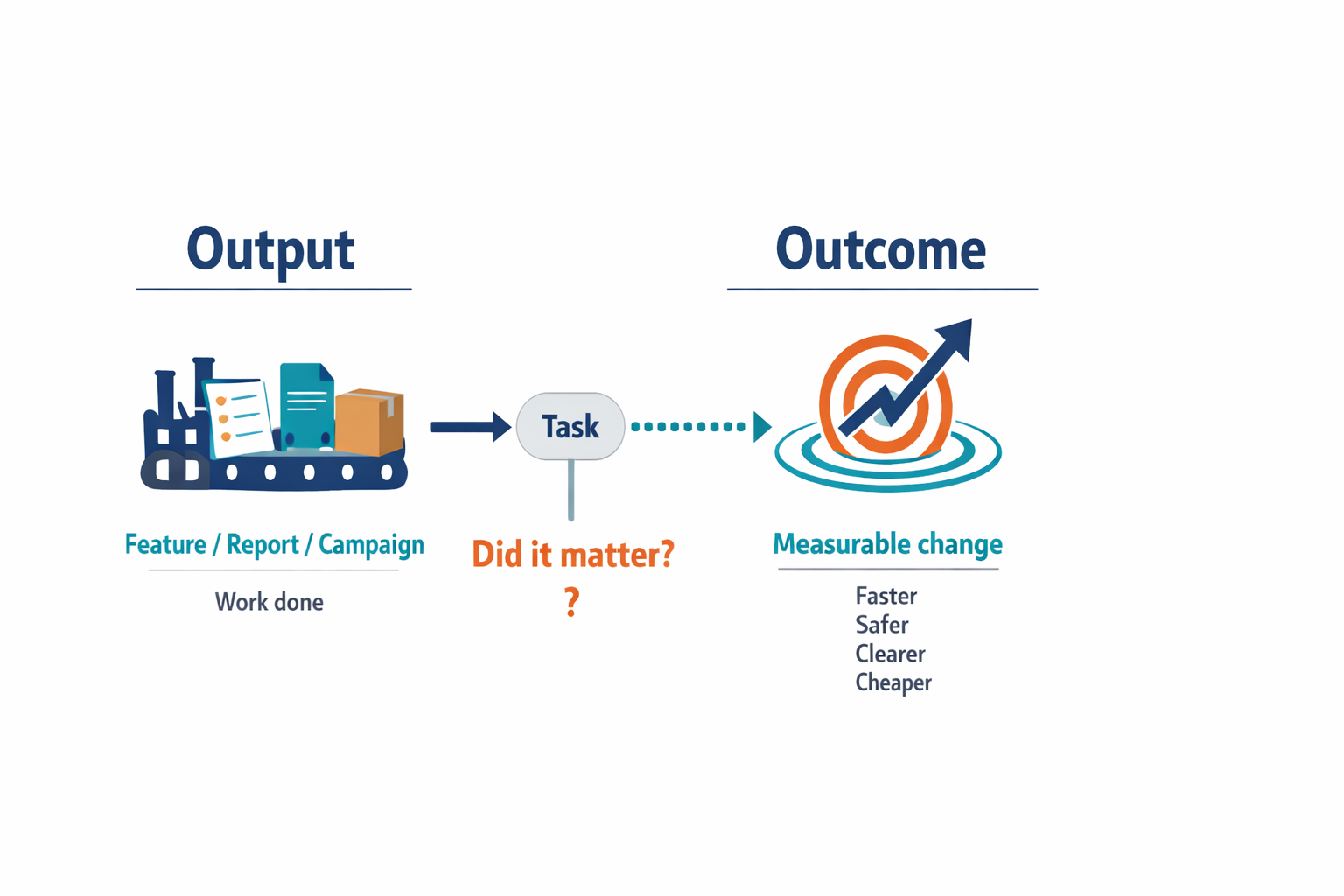
Many organisations confuse output (what we produce) with outcome (what changes because of it).
- Outputs are deliverables — a feature, a report, a campaign, a script.
- Outcomes are the measurable improvements that follow — higher engagement, faster processes, lower error rates, stronger resilience.
ODUI focuses on the latter.
This mindset shift turns planning into purpose. When outcomes drive the conversation, prioritisation becomes factual and fair. Everyone — from executives to engineers — can see how each initiative contributes to the bigger picture.
Quick Examples
-
Output: "Launch new onboarding emails."
Outcome: "Increase week‑1 activation rate by 8%." -
Output: "Build a new internal dashboard."
Outcome: "Reduce time to spot critical incidents from 30 minutes to 5 minutes." -
Output: "Run a training session."
Outcome: "Increase correct process usage from 60% to 85%."
A One-Minute Outcome Check
Before labelling anything as important, run this quick check:
- Can we write the X → Y → Z sentence?
We are doing X to achieve Y outcome, measured by Z. - Is Y linked to a KPI, risk, or clear strategic goal?
- Would we notice if this work never happened?
If the honest answer is “probably not,” importance is low.
Effort describes the cost. Outcome defines the value.
Importance lives at the intersection of both — but in ODUI, it always starts with the outcome.
4.3 The ODUI Importance Criteria
Most prioritisation systems fail because they overcomplicate the scoring process. ODUI takes the opposite approach. It provides a simple, human framework focused on the few questions that truly matter. The goal is not to generate a mathematically perfect score, but to create shared understanding of why something matters and what impact it will have.
ODUI defines importance using five qualitative lenses.
Each lens highlights a different aspect of value.
Scoring is intentionally lightweight: Low, Medium, or High.
What matters most is the reasoning behind each rating — not the number.
Ownership rule (ODUI): Every item scored with the five lenses must have a named Outcome Owner. This person is accountable for the outcome statement and the KPI we expect to move.
The Flow Lead (Delivery Owner) adds delivery context (dependencies, disruption, capacity), so scoring stays honest. If nobody can own the outcome, the item is not ready — park it in B4 until it becomes clear.
The Five Lenses of Importance
| Criterion | Description | Guiding Question |
|---|---|---|
| Outcome Impact | How strongly the work moves a key result or KPI. | “If this succeeds, how much does it move the goal?” |
| Confidence | How certain we are that the work will produce the intended outcome. | “Are we operating on evidence or assumptions?” |
| Reversibility | How easy it is to undo or change course later. | “If we’re wrong, how costly is the correction?” |
| Exposure / Downside | The severity of the downside if we leave it unresolved. | “What value is at risk if we leave this unresolved?” |
| Effort (Contextual) | How disruptive the work is to execute — focus required, coordination load, risk of flow interruption. Not a time estimate. | “Does the gain justify the disruption now?” |
Each criterion answers a different kind of question — together they balance logic, intuition, and reality.
Lens 1 — Outcome Impact: "Does this move the needle?"
This is the heart of importance. If an initiative succeeds, what measurable difference will it make? High-impact work directly shifts KPIs, customer behaviour, or operational results. Medium-impact work provides incremental improvement. Low-impact work might feel good but delivers little visible change.
A useful test: If we delivered this perfectly and nothing changed in our metrics, would we still call it a success? If the answer is yes, the impact is probably low.
In ODUI discussions, teams link every potential item to a KPI or outcome from the KPI Tree. This keeps all effort connected to visible results. The clearer the outcome connection, the higher the impact rating.
Lens 2 — Confidence: "Do we believe it will work?"
Confidence reflects how sure we are that the action will deliver the intended outcome. It is where data meets intuition. A high-confidence task has supporting evidence — user feedback, experiment results, or past performance data. A low-confidence one is still a hypothesis.
Confidence is not about optimism; it is about validation. ODUI encourages teams to ask: "What evidence supports this?" When confidence is low but potential impact is high, teams can plan smaller tests or prototypes first. This transforms assumptions into learning rather than unmanaged risk.
A clear rule:
- High impact with low confidence is innovation territory — a calculated bet.
- Low impact with low confidence is usually noise.
Lens 3 — Reversibility: "Can we undo this later?"
Reversibility measures flexibility. If a decision turns out wrong, how hard is it to recover? Some initiatives are easy to change — a communication plan, a pricing test, a process tweak. Others, like infrastructure investments or legal agreements, are much harder to reverse.
High reversibility means you can safely experiment. Low reversibility requires greater caution and higher confidence before starting. By discussing reversibility openly, teams avoid paralysis or reckless commitments. It allows for strategic boldness where it is safe and careful planning where it is not.
Reversibility protects against fear of failure. When teams know they can adjust, they act faster and learn sooner.
Lens 4 — Exposure / Downside: “What value is at risk if we leave this unresolved?”
Exposure is the “negative impact” side of importance — it makes sure we don’t ignore quiet problems just because they aren’t exciting or visible. Instead of asking what we will gain, we ask what value is at risk if we leave the issue unresolved.
High exposure means the downside is meaningful: revenue leakage, compliance risk, customer harm, reliability degradation, security gaps, or reputational damage. Low exposure means the downside is small, contained, or truly acceptable. This lens is about severity, not speed — urgency is assessed separately by asking how soon the downside will hit and whether delay changes the outcome.
In ODUI reviews, high exposure often signals B1 (Keeps You Alive) or B2 (Builds Your Future) work. If the risk is severe and time-critical, it belongs in B1. If the risk is severe but can be planned and prevented, it belongs in B2. This keeps teams honest about what is genuinely critical versus what is merely loud.
Lens 5 — Effort (Contextual): "Does the gain justify the cost now?"
Please pay close attention to this lens. For many readers, it will feel unfamiliar at first.
In ODUI, effort is not a measure of hours, duration, or delivery time.
It is not an estimation metric.
Effort describes the disruption cost of work:
- how much focus and uninterrupted attention it requires,
- how much coordination is needed across teams,
- how much risk or instability it introduces into the system,
- how much context switching or flow interruption it creates.
This is about energy, complexity, and impact on flow — not calendar time.
Most organisations treat “effort” and “estimation” as the same thing: a time guess.
ODUI intentionally separates them:
- Effort = how disruptive the work is.
- Estimation = how long the work might take.
These are different questions.
- Short tasks can be high effort (intense coordination, major focus disruption).
- Long tasks can be low effort (steady, predictable, low-risk work).
If you come from an agile or engineering background, your brain may map “effort” to time. ODUI uses the word differently — because the time it takes to complete work is a delivery question, not a prioritisation question.
Effort helps you judge whether a task is worth doing now, later, or not yet.
It is contextual: the same work may be high effort for a small team but low effort for a large one.
The question is not “How big is this?”
The question is “Is this the best use of our limited energy (today, this sprint...)?"
Effort is evaluated qualitatively — Small, Medium, Large — to guide sequencing rather than dominate it.
- When value is high and effort reasonable → do it now.
- When value is unclear or effort extreme → refine, reduce, or delay.
Effort helps with sequencing, not scoring.
Start with impact and confidence; finish with effort and feasibility.
The Power of Conversation
The most valuable part of ODUI scoring is not the table — it is the dialogue. Each criterion invites a short discussion that reveals assumptions, dependencies, and blind spots. When people explain why they rate something a certain way, the team learns together.
There is no need for numeric weighting or complex spreadsheets. What matters is that everyone sees the same reasoning. The conversation itself builds alignment and trust.
Teams often use a simple format during scoring sessions:
- Display the criteria on a shared board or document.
- The Intake Lead (Outcome Owner) (or Request Owner) explains the outcome statement.
- Each participant gives a quick initial rating per criterion (Low / Medium / High).
- Discuss differences, focusing on evidence and reasoning.
- Agree on final ratings and document one-sentence justifications.
This short, structured discussion usually takes less than 10 minutes per initiative and avoids endless debate. The result is visible, fair, and repeatable.
A Simple Comparison Example
To make the lenses concrete, imagine two initiatives:
- A. Improve checkout performance — aim to reduce checkout time by 30% for all customers.
- B. Build a custom one-off report for a single internal stakeholder.
A quick ODUI lens view might look like this:
- Outcome Impact: A = High (affects revenue conversion); B = Low–Medium (helps one team).
- Confidence: A = Medium (some data, needs testing); B = High (we know how to do it).
- Reversibility: A = Medium (some work to undo); B = High (can be retired easily).
- Exposure / Downside: A = Medium–High (slow checkout hurts sales); B = Low (delay is tolerable).
- Effort: A = Medium–High; B = Small.
Even without a numeric formula, the conversation makes it clear: A is strategically important B2 work; B is likely B3 — something to schedule without sacrificing A.
Putting It All Together
In practice, ODUI treats importance as a balance of Impact × Confidence × Timing Context. It is not a calculation but a mental model. When these three align — when an action has clear impact, credible confidence, and relevant timing — it deserves priority.
By using these five lenses, teams create a full picture of value, risk, and readiness. They replace subjective judgment with transparent reasoning. Over time, this builds an organisational habit: decisions are made through shared logic, not internal politics.
The goal of scoring is not precision — it is shared understanding. When everyone understands why something matters, commitment follows naturally.
4.4 How to Score in Practice
Scoring importance in ODUI is not a mathematical exercise. It is a structured conversation — a space where data, experience, and judgment meet. The goal is to reach shared understanding, not perfect precision. When done well, scoring becomes one of the most valuable alignment rituals a team can have.
A good scoring session feels more like a dialogue than a ceremony. It is short, focused, and repeatable. Every participant understands what is being discussed and why, and decisions are made in plain language that everyone can defend later.
The ODUI Scoring Rhythm
The process follows a simple rhythm that can be applied at many levels — from daily triage to quarterly planning:
-
Define the outcome statement
The Intake Lead (Outcome Owner) or requester starts by framing the work using ODUI’s outcome format:"We are doing X to achieve Y outcome, measured by Z."
This sets the context and anchors the discussion in purpose, not task lists.
-
Discuss the five criteria
Each criterion — Outcome Impact, Confidence, Reversibility, Exposure, and Effort — is discussed briefly. The team shares evidence, data points, or experience. The emphasis is on why something deserves a particular rating, not just what label to assign. -
Agree on levels
Using simple language (High / Medium / Low), the team records its shared view. The discussion ends when everyone understands the reasoning, even if not everyone fully agrees. The outcome is alignment, not perfect consensus. -
Capture the reasoning
For each criterion, one short justification is written down — usually a sentence or two. These notes become the “audit trail” for future reference. When someone later asks, "Why did we prioritise this?" the answer is visible. -
Add feasibility and risk notes
The Flow Lead (Delivery Owner) (or equivalent) adds context about capacity, dependencies, and potential bottlenecks. This ensures the final view reflects both strategic importance and practical feasibility. -
Review at the right level
Executives and senior leaders review outcomes and patterns, not raw scores. They look for which initiatives drive the biggest outcomes, rather than micromanaging each rating.
Keeping Scoring Collaborative
Scoring loses meaning if it is done in isolation. When one person fills in a spreadsheet alone, bias creeps in. ODUI insists on group discussion because collective reasoning exposes assumptions and strengthens decisions.
The Intake Lead (Outcome Owner) often facilitates the session, but every role contributes:
- Team members share ground-level insight — what is technically possible, risky, or simpler than it looks.
- Flow Leads (Delivery Owners) provide capacity and dependency context.
- Executives or sponsors connect the dots to strategic outcomes.
The best sessions are time-boxed — usually 10–15 minutes per initiative — and end with clear documentation. The key is discipline: short, focused conversations that happen frequently, not long debates that happen rarely.
ODUI principle: Speed through structure. Keep the form light but the logic strong.
A Simple Example
Imagine a team assessing two initiatives:
- A. Improve checkout performance by 20%.
- B. Build a one-off internal reporting dashboard for a single presentation.
After defining outcome statements for both, the team scores them using the five lenses:
-
Outcome Impact
A: High — directly tied to revenue and conversion.
B: Low — useful once, little ongoing impact. -
Confidence
A: Medium — past experiments suggest performance improvements help, but exact impact is uncertain.
B: High — the report will almost certainly be delivered as requested. -
Reversibility
A: High — feature flags and phased rollout allow rollback if needed.
B: Medium — time spent cannot be recovered; dashboard may go unused. -
Exposure / Downside
A: High — continued revenue leakage and user frustration.
B: Low — a slightly weaker presentation, but no lasting damage. -
Effort (contextual)
A: Medium — requires coordinated changes and a careful rollout.
B: Medium — requires stakeholder alignment and interrupts delivery flow for low long-term value.
The conversation quickly reveals that A belongs in B2 (Makes You Great) and deserves near-term focus, while B sits firmly in B3 (Keeps Others Quiet) and should be time-boxed or de-scoped.
The scores do not decide on their own — the discussion does. The criteria simply make that discussion faster, clearer, and less emotional.
Making Scoring Visible
Once scores and reasoning are agreed, the results should live in a shared space — an ODUI intake form, backlog view, or dashboard. Visibility ensures accountability. It also eliminates “hidden prioritisation”, where decisions happen informally or emotionally after the meeting.
Transparency builds trust. When everyone can see why something was rated high or low, there is less need for backroom discussions or defensive escalation. It becomes easier to say “no” because the logic is visible to all.
Regular re-scoring keeps decisions alive. Context shifts — new data emerges, goals change, or external pressures rise. In ODUI, teams revisit importance scores every few weeks or at the start of each planning cycle. This keeps prioritisation relevant and prevents old logic from steering new realities.
From Scoring to Story
Each scoring result tells a small story about how a team thinks. When you read multiple entries together, patterns appear — where confidence is low, where effort is consistently high, or where outcomes are unclear.
These patterns become insight. They help leaders decide where to invest, simplify, or learn more. They highlight which areas need more discovery, more capability, or more focus.
Scoring, then, is more than an exercise. It is a learning system that keeps decision-making transparent, adaptive, and fair.
ODUI treats importance as a living dialogue, not a static ranking. It evolves as your understanding, data, and strategy evolve. The goal is never to freeze a list — it is to keep improving the logic that guides it.
4.5 When Effort Should (and Shouldn’t) Matter
In many organisations, “effort” becomes a shortcut for avoidance. Work that sounds complex, disruptive, or cross‑team is pushed down the list — even when it would move a key outcome. At the same time, small and convenient tasks rise to the top because they feel easy to finish. The result is a backlog full of activity, but very little progress.
ODUI keeps effort in the model, but it gives it a clear meaning and a clear boundary. As defined in Lens 5, effort is disruption cost — focus required, coordination load, and risk of flow interruption — not a delivery time estimate.
Effort as Context, Not Control
Effort should never be the first filter. ODUI starts with outcomes: impact, evidence, reversibility, and downside. Once the value story is clear, effort becomes the final reality check:
“Does the gain justify the disruption right now?”
This protects the team from two common mistakes:
- Doing low‑value work simply because it is convenient.
- Avoiding high‑value work simply because it is demanding.
A simple map helps:
- Low disruption, low impact: Usually not worth attention.
- Low disruption, high impact: Great candidates for early wins and fast learning.
- High disruption, high impact: Strategic investments — plan them, protect them, deliver them steadily.
- High disruption, low impact: Redesign, reduce scope, or park it.
Effort as a Multiplier
ODUI treats effort as a multiplier, not a veto.
The first four lenses tell you whether something is valuable and real. Effort then adjusts your choice by showing the execution cost to the system — how much focus and coordination it will consume.
In practice, this means:
- Use effort to sequence work, not to dismiss it.
- Use effort to make trade‑offs visible ("If we do this now, what must pause?").
- Large‑effort items can still be high priority when the outcome is mission‑critical.
- Small‑effort items are not automatically urgent — they still need a real outcome.
Rule of thumb: Effort measures disruption cost, not worth.
Effort and Fair Workload
Effort discussions also protect teams from overcommitment. Flow Leads (Delivery Owners) use effort ratings to balance workload and protect flow. If a team’s capacity is already filled with B1 and B2 items, adding another high‑disruption initiative creates strain and delays.
Effort can also signal opportunity. When two initiatives have similar importance, the one with lower disruption may be delivered first to unlock quick learning or early results. But this remains a sequencing decision, not a redefinition of importance.
The Effort Illusion
Many organisations fall into what ODUI calls the effort illusion — believing that doing more equals achieving more. In reality, teams that chase efficiency without clarity simply run faster in the wrong direction. True productivity comes from doing fewer things that matter most, regardless of disruption size.
In summary, effort is a helpful lens for sequencing and sustainability, but a dangerous one for proving importance. Use it to balance your rhythm, not to decide your purpose.
Effort shapes when you do it — not whether it matters.
4.6 Maintaining Alignment Across Roles
ODUI is built on collaboration. Its power comes not from the scoring table itself, but from how people use it together. When each role understands its responsibility in defining, reviewing, and applying importance, prioritisation becomes a source of unity rather than tension.
Alignment across roles ensures that every decision connects the why of strategy to the how of execution. It prevents silos, clarifies accountability, and replaces personal interpretation with shared understanding.
Shared Accountability
Each role in the ODUI process carries a distinct responsibility:
| Role | Core Responsibility | Contribution |
|---|---|---|
| Intake Lead (Outcome Owner) | Define outcomes and rationale. | Translates business goals into measurable outcomes. Holds the narrative of “why this matters.” |
| Flow Lead (Delivery Owner) | Match importance to capacity. | Ensures the work pipeline is achievable. Balances ambition with resources and protects delivery flow. |
| Team Members | Validate assumptions. | Bring practical insight — what’s technically possible, what risks exist, and how confidence can be strengthened through experimentation or data. |
| Executives | Maintain strategic alignment. | Set direction, approve high-importance items, and ensure priorities reflect the organisation’s most critical outcomes — not personal preference or hierarchy. |
This collaboration closes the traditional gap between strategy, planning, and delivery. It allows every level of the organisation to speak a common language of importance.
The Vertical Chain of Clarity
ODUI creates a “vertical chain” that connects the organisation’s goals with the daily actions of its teams:
- Strategy — Executives define the outcomes that matter most.
- Priorities — Intake Leads translate those outcomes into initiatives and measurable targets.
- Execution — Teams plan and deliver based on clear importance and validated confidence.
- Results — Flow Leads and Intake Leads measure progress against KPIs and feed learning back into the system.
This chain keeps the organisation moving in rhythm — strategy at the top, learning at the bottom, and clarity flowing between them.
Building Alignment Habits
Alignment is not achieved through documentation alone. It’s a habit that grows through rhythm and communication. ODUI encourages:
-
Regular joint reviews between Intake Leads, Flow Leads, and executives to rescore and adjust priorities.
-
Transparent dashboards that show how scoring decisions connect to outcomes.
-
Open feedback loops where teams can challenge or refine importance logic when context changes.
These habits keep everyone engaged in the reasoning behind decisions, not just the results. Over time, this turns ODUI from a framework into a culture — one where clarity is constant and alignment automatic.
Alignment replaces argument. When everyone understands how importance is defined and who owns which part of the process, trust grows naturally. People stop defending their opinions and start defending the shared outcome.
In a mature ODUI environment, importance is no longer a mystery. It’s visible, logical, and owned collectively. The result is a team that moves together — focused, balanced, and confident that every hour of work serves a purpose.
Importance becomes a shared truth that drives focus, trust, and performance.
4.7 The ODUI Language
Here are the new ODUI terms introduced or used heavily in this chapter.
New ODUI terms (Chapter 4)
| Term | Meaning |
|---|---|
| Evidence-based logic | Making importance decisions using facts, outcomes, and measures — not titles, drama, or opinions. |
| Outcome statement (X → Y → Z) | “We are doing X to achieve Y outcome, measured by Z.” A fast way to make intent measurable. |
| One-minute outcome check | Three quick questions to test whether something is truly important (outcome sentence, KPI link, and “would we notice if it never happened?”). |
| Five lenses of importance | Outcome Impact, Confidence, Reversibility, Exposure / Downside, and Effort (contextual). A lightweight way to score importance. |
| Outcome Impact | How much the work is expected to move a key KPI or result. |
| Confidence | How much evidence suggests the work will succeed (vs assumptions). |
| Reversibility | How hard it is to undo or change course if the decision is wrong. |
| Exposure / Downside | The severity of the downside if we leave something unresolved (loss, penalty, trust damage, safety risk). |
| Effort (contextual) | How disruptive the work is to execute (focus, coordination, risk to flow) — not a time estimate. |
| Estimation | A delivery question: how long work might take. (Separate from effort in ODUI.) |
| Audit trail | Short written reasons for scores, so the decision stays explainable later. |
| Re-scoring | Revisiting importance when context changes (new data, new goals, new risks). |
| Effort illusion | The belief that doing more means achieving more, even when outcomes don’t move. |
| Vertical chain of clarity | The line from strategy → priorities → execution → results, kept connected by outcomes and KPIs. |
| KPI Tree (introduced later) | A map that shows how KPIs link together, making outcome impact easier to trace. |
Core ODUI questions (Chapter 4)
- Outcome clarity: Can we write the X → Y → Z outcome statement?
- KPI link: Which KPI (or signal) will prove success?
- Importance check: Would we notice if this never happened?
- Confidence: What evidence supports this? What assumptions are we making?
- Reversibility: If we’re wrong, how costly is the correction?
- Exposure / Downside: What value is at risk if we leave this unresolved?
- Effort (contextual): Does the gain justify the disruption now?
- Large effort items can still be high priority if the outcome is mission-critical.
- Small effort items are not automatically urgent — they must still prove their value.
Rule of thumb: Effort measures cost, not worth.
Effort and Fair Workload
Effort discussions also protect teams from overcommitment. Flow Leads (Delivery Owners) use effort estimates to balance workloads across ODUI buckets. If a team’s capacity is already filled with B1 and B2 items, adding another high-effort project creates strain and delays. Effort visibility ensures the team remains realistic — working at a sustainable pace while still focusing on high-impact outcomes.
Effort can also signal opportunity. When two initiatives have similar importance, the one requiring less effort may be delivered first to unlock quick learning or early results. But this is a sequencing decision, not a redefinition of importance.
The Effort Illusion
Many organisations fall into what ODUI calls the effort illusion — believing that doing more equals achieving more. In reality, teams that chase efficiency without clarity simply run faster in the wrong direction. True productivity comes from doing fewer things that matter most, regardless of their effort size.
In summary, effort is a helpful lens for planning, but a dangerous one for prioritising. Use it to balance your rhythm, not to decide your purpose.
Effort shapes when you do it — not whether you should.
4.6 Maintaining Alignment Across Roles
ODUI is built on collaboration. Its power comes not from the scoring table itself, but from how people use it together. When each role understands its responsibility in defining, reviewing, and applying importance, prioritisation becomes a source of unity rather than tension.
Alignment across roles ensures that every decision connects the why of strategy to the how of execution. It prevents silos, clarifies accountability, and replaces personal interpretation with shared understanding.
Shared Accountability
Each role in the ODUI process carries a distinct responsibility:
| Role | Core Responsibility | Contribution |
|---|---|---|
| Intake Lead (Outcome Owner) | Define outcomes and rationale. | Translates business goals into measurable outcomes. Holds the narrative of “why this matters.” |
| Flow Lead (Delivery Owner) | Match importance to capacity. | Ensures the work pipeline is achievable. Balances ambition with resources and protects delivery flow. |
| Team Members | Validate assumptions. | Bring practical insight — what’s technically possible, what risks exist, and how confidence can be strengthened through experimentation or data. |
| Executives | Maintain strategic alignment. | Set direction, approve high-importance items, and ensure priorities reflect the organisation’s most critical outcomes — not personal preference or hierarchy. |
This collaboration closes the traditional gap between strategy, planning, and delivery. It allows every level of the organisation to speak a common language of importance.
The Vertical Chain of Clarity
ODUI creates a “vertical chain” that connects the organisation’s goals with the daily actions of its teams:
- Strategy — Executives define the outcomes that matter most.
- Priorities — Intake Leads translate those outcomes into initiatives and measurable targets.
- Execution — Teams plan and deliver based on clear importance and validated confidence.
- Results — Flow Leads and Intake Leads measure progress against KPIs and feed learning back into the system.
This chain keeps the organisation moving in rhythm — strategy at the top, learning at the bottom, and clarity flowing between them.
Building Alignment Habits
Alignment is not achieved through documentation alone. It’s a habit that grows through rhythm and communication. ODUI encourages:
- Regular joint reviews between Intake Leads, Flow Leads, and executives to rescore and adjust priorities.
- Transparent dashboards that show how scoring decisions connect to outcomes.
- Open feedback loops where teams can challenge or refine importance logic when context changes.
These habits keep everyone engaged in the reasoning behind decisions, not just the results. Over time, this turns ODUI from a framework into a culture — one where clarity is constant and alignment automatic.
Alignment replaces argument. When everyone understands how importance is defined and who owns which part of the process, trust grows naturally. People stop defending their opinions and start defending the shared outcome.
In a mature ODUI environment, importance is no longer a mystery. It’s visible, logical, and owned collectively. The result is a team that moves together — focused, balanced, and confident that every hour of work serves a purpose.
Importance becomes a shared truth that drives focus, trust, and performance.
4.7 The ODUI Language
Here are the new ODUI terms introduced or used heavily in this chapter.
New ODUI terms (Chapter 4)
| Term | Meaning |
|---|---|
| Evidence-based logic | Making importance decisions using facts, outcomes, and measures — not titles, drama, or opinions. |
| Outcome statement (X → Y → Z) | “We are doing X to achieve Y outcome, measured by Z.” A fast way to make intent measurable. |
| One-minute outcome check | Three quick questions to test whether something is truly important (outcome sentence, KPI link, and “would we notice if it never happened?”). |
| Five lenses of importance | Outcome Impact, Confidence, Reversibility, Risk/Exposure, and Effort (contextual). A lightweight way to score importance. |
| Outcome Impact | How much the work is expected to move a key KPI or result. |
| Confidence | How much evidence suggests the work will succeed (vs assumptions). |
| Reversibility | How hard it is to undo or change course if the decision is wrong. |
| Risk / Exposure | The cost of doing nothing or delaying (loss, penalty, trust damage, safety risk). |
| Effort (contextual) | How disruptive the work is to execute (focus, coordination, risk to flow) — not a time estimate. |
| Estimation | A delivery question: how long work might take. (Separate from effort in ODUI.) |
| Audit trail | Short written reasons for scores, so the decision stays explainable later. |
| Re-scoring | Revisiting importance when context changes (new data, new goals, new risks). |
| Effort illusion | The belief that doing more means achieving more, even when outcomes don’t move. |
| Vertical chain of clarity | The line from strategy → priorities → execution → results, kept connected by outcomes and KPIs. |
| KPI Tree (introduced later) | A map that shows how KPIs link together, making outcome impact easier to trace. |
Core ODUI questions (Chapter 4)
- Outcome clarity: Can we write the X → Y → Z outcome statement?
- KPI link: Which KPI (or signal) will prove success?
- Importance check: Would we notice if this never happened?
- Confidence: What evidence supports this? What assumptions are we making?
- Reversibility: If we’re wrong, how costly is the correction?
- Risk/exposure: What happens if we do nothing?
- Effort (contextual): Does the gain justify the disruption now?